The Matching Set Myth in Outdoor Furniture
Outdoor furniture need not come as a matching set. Repeat colour, material or shape to make mixed pieces feel connected and keep the patio useful.
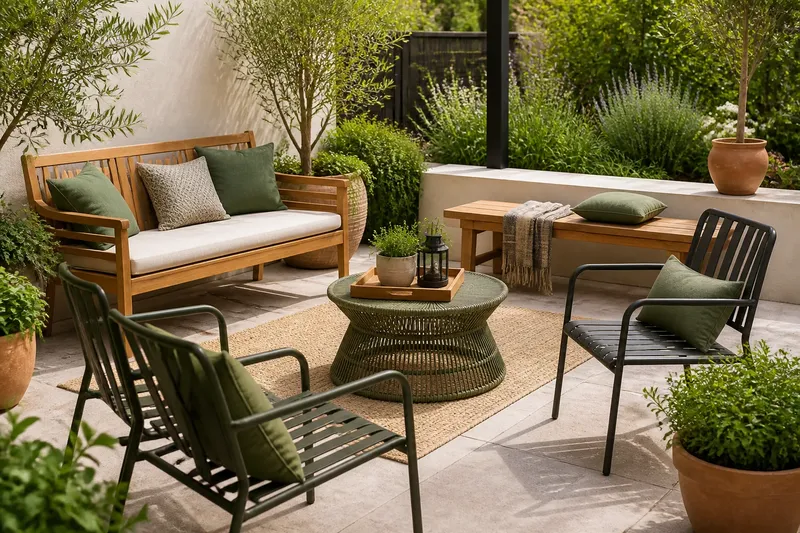
Outdoor furniture looks coherent without coming from the same range. A patio can bring together a teak bench, painted metal chairs and a woven side table if one or two visual qualities recur; the result feels chosen rather than assembled by catalogue.
The useful shift is to treat matching as repetition, not duplication. These seven ways to connect unlike pieces help you keep the character of individual finds while making the arrangement read as one place.
1. Repeat one colour, not every finish
A shared colour is an easy link between furniture made from different materials. Choose a colour already present in the setting—a dark green railing, terracotta pots or the muted grey of paving—and repeat it on a cushion, chair frame or outdoor planter nearby.
Keep the colour in a supporting role if the furniture itself has strong grain or texture. For instance, a natural timber bench and black aluminium chairs can sit comfortably together if a few charcoal details recur in cushions or a lantern. The connection is visible without making every surface identical.
Colour can come from removable pieces, which makes it easier to adjust the arrangement as cushions fade or tastes change. Check how the shade looks in the actual outdoor light: a colour that seems subtle in a shop can appear much brighter beside pale stone or a white wall.
2. Let material texture do the connecting
Different furniture materials can share a tactile quality. A slatted timber chair, a woven resin stool and a metal table with a perforated top all have open, linear details; that repeated sense of lightness can make them feel related even when their finishes differ.
Alternatively, pair pieces with contrasting textures but repeat one material in a small accent. A smooth powder-coated table might sit beside a rough-hewn bench, while a timber tray or a wooden chair arm gives the eye a familiar point of contact. The aim is not to disguise each material, but to create a quiet link.
Consider how surfaces will feel and age in your particular spot. A covered porch may suit natural wicker or untreated-looking timber, while an exposed terrace can call for weather-resistant finishes that are easier to care for. Follow the furniture label and manufacturer’s care instructions when choosing products or treatments.
3. Connect pieces through shape and line
Shape gives an arrangement a rhythm. Rounded chair backs can echo the curve of a circular table, while straight-edged benches and rectangular planters reinforce a more architectural setting. Furniture need not have the same silhouette; a repeated curve, angle or slat pattern can be enough.
Look for the outline of each piece from the main viewpoint, such as the kitchen door or a garden path. A tall-backed chair can balance a low bench if another vertical element, perhaps a slim planter or parasol pole, appears nearby. This helps the grouping feel composed without lining every chair up like a dining set.
Avoid adding a shape just to force a connection. If the garden already has strong curves in its borders, a few rounded furniture details may be sufficient; extra circular accessories can make the arrangement feel busier rather than more coherent.
4. Keep the visual weight in balance
Visual weight is the sense that an object looks substantial or light. A chunky timber table can dominate delicate wire chairs, even if their colours match. Balance that difference by distributing heavier pieces across the seating area instead of clustering them on one side.
Open frames, pale finishes and woven surfaces tend to look visually lighter than solid panels or dark, bulky forms. This does not mean the pieces must be identical in size: a substantial bench can anchor the grouping while lighter chairs preserve a sense of openness around it.
Imagine you have a compact paved patio with a broad timber bench and two slim metal chairs. Place the bench along the back wall, angle the chairs towards it, and repeat the bench’s warm tone in a small timber tray. The expected observable result is a clear seating group with a visible link, while the narrow chair frames keep the patio from feeling crowded.
5. Repeat a detail rather than a whole piece
A small feature can provide continuity when the main furniture varies. Look for details such as woven backs, slatted seats, rounded arms, simple black feet or a particular kind of hardware. Repeating one detail across separate pieces makes the arrangement feel considered without requiring a matching collection.
This works especially well when you are collecting furniture gradually. A second-hand chair might have a different finish from an existing table, but a shared curve in the legs or a similar woven panel can connect them. If the features are not obvious at first glance, use a cushion or outdoor textile to make the relationship easier to see.
Do not worry about matching every screw, weave or timber tone. Those tiny variations are rarely worth the effort of replacing a useful piece, and they can make an outdoor setting look overly coordinated.
6. Use textiles as a flexible bridge
Cushions, seat pads and outdoor rugs can bring varied furniture into the same visual family. A restrained pattern can link a plain bench to painted chairs, while a single solid colour can calm a mix of strong finishes. Keep the scale of a pattern in proportion to the space: a large motif can overwhelm a small balcony.
Textiles also help define which pieces belong together. A rug beneath a table and chairs marks a dining spot, while cushions in a repeated colour can connect a nearby bench to that group without making it part of the same exact set. Leave walking routes clear and choose fabrics suited to the exposure of the area.
Textiles are a flexible choice because they can be removed, stored or changed without altering the furniture. They are not a cure for a layout that blocks access or leaves seats facing away from conversation, so settle the arrangement before adding decorative layers.
7. Repeat qualities at different scales
A visual quality does not have to appear in the same form each time. A deep blue chair frame, a smaller blue cushion and a blue glaze on a nearby pot can create a gentle progression. Likewise, a linear slat pattern on a bench might be echoed by the narrow leaves of ornamental grasses, without turning the planting into a furniture accessory.
Varying scale keeps repetition from feeling mechanical. Let one element be prominent and allow the others to appear as accents; when every colour and shape competes equally, the arrangement can lose its focal point.
Think of the patio as a whole view rather than a furniture catalogue. Check what appears behind and around the seating—fence boards, pots, paving joints and planted borders can all contribute a repeated line, colour or texture. The furniture may need only a modest connection to feel at home there.
Which outdoor furniture details should you repeat?
Can different outdoor furniture materials work together?
Yes. Timber, metal and woven synthetic materials can sit together when a colour, shape or level of visual weight connects them. Consider their practical care needs separately from the design relationship.
How many colours should an outdoor seating area use?
There is no fixed number that suits every space. Start with the colours already present in paving, walls or planting, then repeat one of them in furniture or textiles so the grouping has a clear point of connection.
Do all patio chairs need to match the table?
No. Chairs can differ from the table in material or finish if their scale and shape suit its use. A shared detail, such as a dark frame or rounded edge, can tie the pieces together.
What should you do with a furniture piece that feels out of place?
First try changing its position or connecting it through a cushion, tray or nearby accent. If it still disrupts the arrangement and is awkward to use, it may work better elsewhere rather than being altered solely to match.
The matching set myth is easiest to leave behind when you choose a clear thread before adding more furniture. Repeat a colour, texture, shape or detail, then stop once the pieces belong together and the space still works for the way you sit, eat and move outdoors.